Cursive vs print: which handwriting style should you learn?
It's the wrong fight, mostly. The internet's cursive-vs-print debate is powered by nostalgia on one side and "nobody writes anymore" on the other. Meanwhile the research says something boring and useful: a practiced hand wins, whichever alphabet it uses — and most adults benefit from a working knowledge of both.
Here's the honest comparison — speed, legibility, learning curve, everyday usefulness — so you can pick a lane for the right reasons.
The scoreboard
| Factor | Cursive | Honest verdict | |
|---|---|---|---|
| Speed, trained adult | Fast once fluent (fewer pen lifts) | Solid but more pen lifts | Cursive's edge is real but smaller than legend says |
| Legibility for strangers | Depends heavily on the writer | Generally higher floor | Print is safer on forms, labels, mail |
| Learning curve (adult) | 3–6 weeks of short daily drills | You already have it | Print wins for beginners |
| Fast note-taking | Excellent when fluent | Good | Many pros blend: print letters, cursive connectors |
| Everyday documents | Signatures, cards, letters, journals | Forms, labels, whiteboards | You need both, honestly |
| Reading old letters/family documents | Required | Won't help | Cursive is a literacy skill here |
| Kid learning first style | Standard advice: print first, cursive ~2nd–3rd grade | — | Sequence, don't choose |
What studies actually show
- Research on handwriting fluency (summarized well in work by Steve Graham and colleagues) finds handwriting legibility and speed correlate with better composition in students — but the style matters less than automaticity. A fluent printer outperforms a rusty cursive writer every time;
- The frequently repeated claim that "cursive is always faster" comes from Palmer-method-era training. Modern comparisons are messier: trained cursive writers tend to beat trained printers on speed because words flow without pen lifts, but well-practiced printers close much of the gap;
- The brain-development findings (letter formation activating reading networks in young children — e.g., James & Engelhardt, 2012) apply to forming letters by hand, not to cursive specifically. Cursive is not a nootropic. For the state-of-cursive context, see is cursive still taught in schools.
So which should you learn?
Learn/fix print if: your handwriting is already messy print and strangers struggle to read it. Print is the higher-leverage fix — diagnose size, spacing, slant and baseline with the 4-week adult handwriting plan.
Learn cursive if: any of these are true —
- You want a faster personal hand for journaling and letters (cursive's real advantage: less fatigue over long writing);
- You need to read it — family letters, historical documents, grandma's recipes;
- You care about signatures and handwritten cards looking deliberate (cursive name and signature method);
- Your state's schools expect it and you're supporting a kid through it.
Learn the hybrid if you're practical: most fast adult handwriting ends up as print-shaped letters with cursive connectors and a couple of unjoined tails. It's not a style failure; it's how efficient hands actually evolve.
The crossover trick: train both with the same words
Whichever style you're adding, the practice loop is identical:
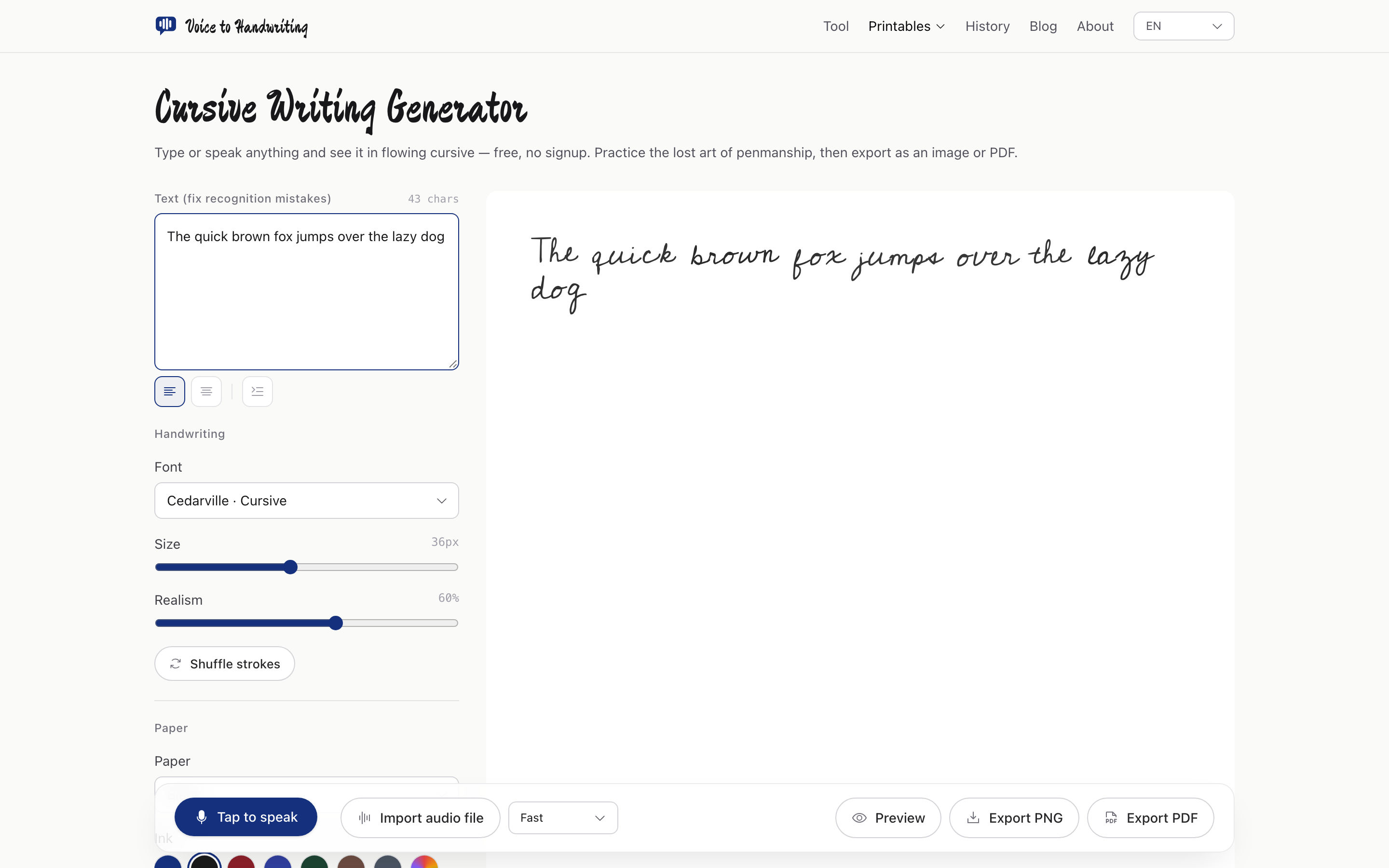
- Type your practice sentence into the cursive writing generator — it renders in Cedarville Cursive or Dancing Script;
- Print it, trace once, copy twice freehand on printable lined paper;
- Switch the generator to print-style fonts (Patrick Hand, Kalam) and repeat with the same sentence to keep both hands honest.
Same words, two styles, one sheet — and comparing the two renders side by side teaches you more about letterform differences than any chart. The cursive worksheets generator lays these trace-and-copy sheets out for you, with cursive or print rows on three-line guides.
Tested, with honest limitations
- The generator renders your text in real handwriting fonts for tracing practice — it doesn't grade your freehand output, and no tool honestly can yet;
- Speed claims in this piece are population tendencies, not promises; your hand will have opinions;
- Free, browser-based, nothing you type is uploaded.
People also ask
- Is cursive faster than print? For trained writers, usually yes — cursive has fewer pen lifts per word — but the gap is modest and a fluent printer can match a casual cursive writer.
- Is cursive better for the brain? Forming any letters by hand shows cognitive benefits over typing for young learners; studies haven't shown cursive specifically outperforming print.
- Should kids learn print or cursive first? Print first — it matches early reading instruction; cursive typically joins the picture around 2nd–3rd grade, now required in 20+ states.
- Why do forms ask you to print instead of write in cursive? Legibility: print has a higher readability floor for strangers, especially on names and addresses where mistakes are costly.