How to improve your handwriting as an adult (a 4-week plan)
Adult handwriting rarely gets better on its own — but it improves faster than you'd expect with deliberate practice, because the problem is almost never your hand. It's size, spacing, and speed. Fix those three and most people's writing becomes perfectly pleasant within a month.
Here's a four-week plan with drills, plus how to generate custom practice sheets from your own sentences for free.
Step 1: diagnose — which of the four levers is off?
Write the same sentence three times, then check it against this list:
| Problem | What it looks like | The fix |
|---|---|---|
| Inconsistent size | Some letters tall, some tiny | Fill ruled bands fully — commit to the line height |
| Drifting baseline | Lines sag or climb across the page | Use ruled paper; focus on the last letter of each word |
| Crowding | Words blur together | Two finger-widths of space between words |
| Slant chaos | Letters lean every direction | Pick one slant (even 90°) and hold it for a whole line |
Slow down 20–30% while you drill. Neat-then-fast comes back naturally; fast-then-neat never does.
The 4-week plan (15 minutes a day)
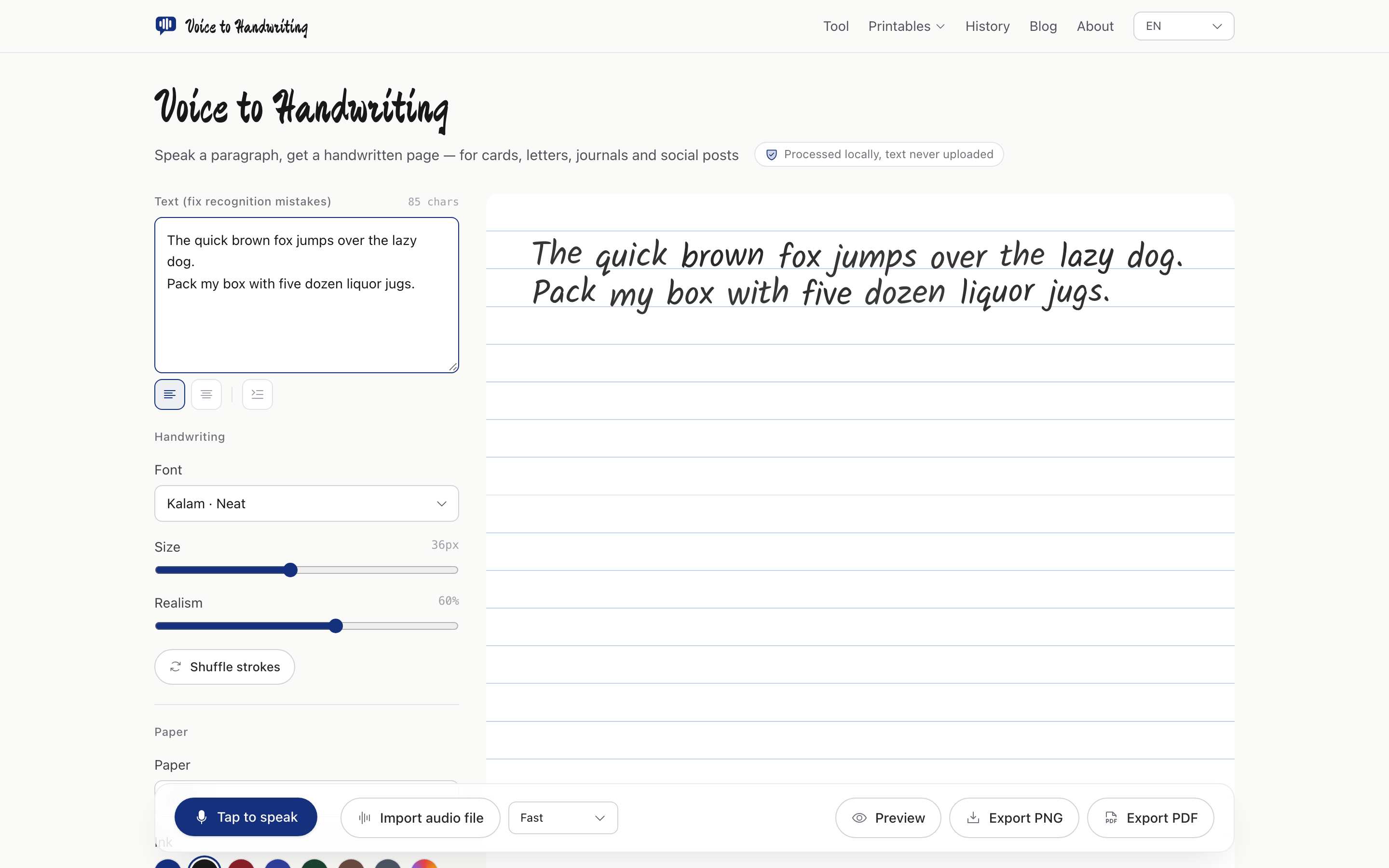
Week 1 — size and rails. Warm up with rows of ovals and push-pull strokes (3 min). Then write pangrams — "The quick brown fox jumps over the lazy dog" — on printed handwriting paper, deliberately filling each band top to bottom. No freehand yet.
Week 2 — spacing and rhythm. Same drills, but now exaggerate word gaps: place two fingers between words. Write one line of pangrams, one line of a sentence you actually wrote this week (a text, a grocery item). Rhythm over beauty.
Week 3 — your own words. This is where a custom worksheet beats any workbook: type 3–5 sentences you wrote — meeting notes, a birthday card draft, your address — into the handwriting tool and print the page. Copy each line twice beneath it, eyes on the model. Practicing your real vocabulary builds the muscle memory you'll actually use.
Week 4 — speed and freehand. Copy the same sentence freehand, then at full speed. Trace once, write twice, speed once. Take a "before" photo of your writing from week 1 and compare — the gap is usually bigger than you expect.
Tools that help (and one habit that doesn't)
- A pen that glides — a gel pen (0.5–0.7mm) removes the "I have to press" problem fountain-pen people pay to solve;
- Guided sheets for names and phrases — the name tracing generator isn't just for kids: set the row height smaller, type your signature or address, and trace it in adult-sized bands;
- One sentence, one problem — when you already know which lever is off, print that sentence on the sentence practice sheet: a model line, a dotted line, and three blank lines, then stop;
- Consistency beats duration — 15 focused minutes daily outperforms a weekend bootcamp; motor memory consolidates with sleep;
- The habit that doesn't help: writing more fast notes. Quantity at bad settings just rehearses the bad settings.
Tested, with honest limitations
- Expect legible and consistent within 4–6 weeks of daily practice; "beautiful" is a longer road and depends on the style you're chasing;
- Hand pain that doesn't fade when you slow down is a grip or ergonomics issue, not a practice issue — lighten up, bigger pen barrel, and if it persists, get it checked;
- The generators are free, browser-based, and nothing you type is uploaded.
People also ask
- Can you fix handwriting as an adult? Yes — size, spacing and baseline issues respond to a few weeks of deliberate drill at slower speed; most adults see clear improvement within a month.
- What are good handwriting practice sentences? Pangrams first (every letter once), then sentences from your own writing — the vocabulary you'll actually write by hand.
- How long does it take to improve handwriting? About 15 minutes a day for 4 weeks to fix consistency; 2–3 months for a genuinely different style.
- Is it better to print or write in cursive for neatness? Whichever you use less often — the "fresh" style lacks your bad habits, which is why many adults improve faster relearning cursive.