Is cursive still taught in schools? What changed, and what's next
Short answer: yes, in more states than five years ago — but it depends where you live.
Long answer: cursive was quietly dropped from most US classrooms for about a decade, and has been loudly coming back since 2016. Here's the actual timeline, the states that require it now, and what the research does (and doesn't) say — because the cursive debate attracts a lot of overclaiming on both sides.
How cursive left the classroom
In 2010, the Common Core State Standards — adopted by 40+ states — set grade-level expectations for English language arts. They required keyboarding proficiency. They did not mention cursive. State education agencies, implementing standards on tight schedules, largely followed suit: districts stopped buying cursive workbooks, teacher-prep programs stopped teaching how to teach it, and by the mid-2010s many elementary students never got a cursive unit at all.
Then the pendulum swung back. Starting around 2016, state after state wrote cursive back into their standards — a movement often attributed to a mix of teacher advocacy, historical-document literacy, and concerns about fine-motor development.
Where cursive is required now
More than twenty states have restored cursive requirements (the count varies slightly by how you score "requirement" — check your own state's ELA standards for the current language). Notable examples:
Looking for your state? The full table — bill numbers, grade levels, effective dates, updated for 2026 — lives in cursive laws by state.
- California — AB 446, signed in October 2023 and effective from January 2024, requires cursive instruction in grades 1–6 (California Legislative Information);
- Texas — state ELA standards have students learning cursive through elementary school and writing legibly in cursive by fourth grade (Texas Education Agency);
- Arizona, Arkansas, Louisiana, North Carolina, Tennessee, Virginia, Kentucky and South Carolina, among others, have cursive mandates or recommended standards in elementary grades.
The pattern to know as a parent: even where cursive is required, it often gets a few weeks in one grade rather than the multi-year drilling older generations had. That's why "my kid's school teaches cursive" and "my kid can actually write cursive" are frequently different claims.
What research actually says (and doesn't)
- Handwriting builds letter knowledge in young children. A 2012 fMRI study by Karin James and Laura Engelhardt at Indiana University (Trends in Neuroscience and Education) found that children who practiced forming letters by hand showed stronger activation in reading-related brain networks than children who only traced or typed them;
- Fluency helps composition. Research by Virginia Berninger at the University of Washington found elementary students tended to write more words, faster, when composing essays by hand than by keyboard;
- The "handwritten notes are magic" claim is overstated. The famous 2014 "pen is mightier than the keyboard" study (Mueller & Oppenheimer, Psychological Science) found longhand note-takers outperformed laptop note-takers on conceptual questions — but later replication attempts have been mixed, so treat it as suggestive, not settled;
- No strong evidence cursive beats print. For legibility and speed, studies generally find practiced printers and practiced cursive writers land in similar territory. The benefits above come from forming letters by hand at all, not from cursive specifically.
Honest takeaway: cursive is a worthwhile skill — for reading grandma's letters, signing documents, writing a faster personal hand, and getting the fine-motor practice that letter formation provides. It is not a superpower, and adults who "must relearn cursive for their brain" are being sold something.
What to do about it, by situation
- Parent in a cursive-requirement state: ask when it's taught and whether it's more than a one-week unit. If it's thin, 10 minutes a week at home covers the gap — see how to teach cursive at home;
- Parent in a state without requirements: cursive is optional, so make it optional fun — a "grown-up writing style" novelty rather than homework;
- Adult who never learned it: the stroke-first method takes about a month of short sessions — how to write in cursive from zero;
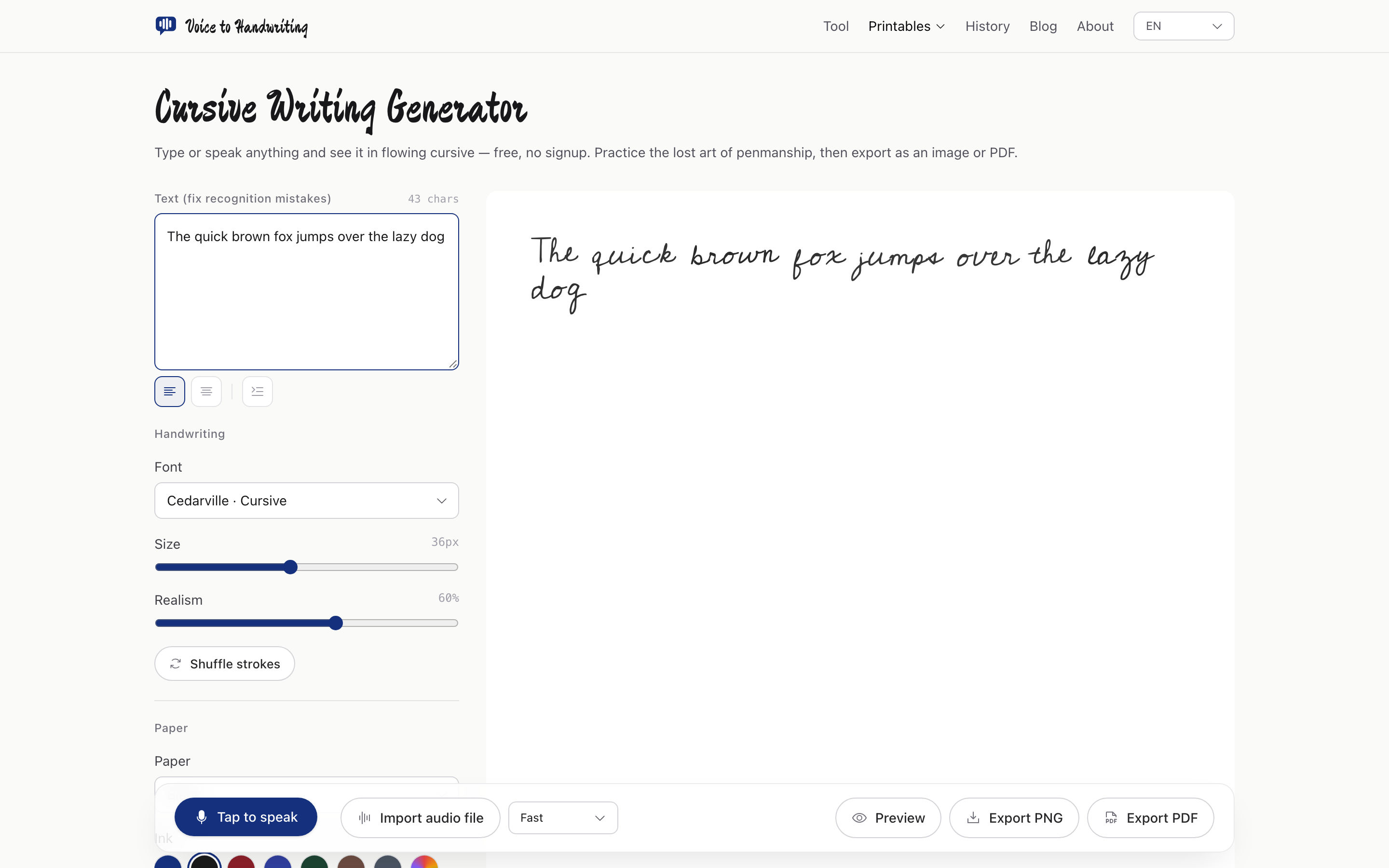
- Anyone practicing: type words into the cursive writing generator, print, and trace — the same model-tracing loop classrooms use.
Sources & honesty notes
State mandates above reflect standards as of late 2026 and are the kind of thing that changes — verify against your state's current ELA standards. Research summaries are deliberately hedged where replications are mixed; we link primary institutions rather than press coverage wherever possible. This page was last reviewed October 2026.
People also ask
- Do schools still teach cursive in 2026? In 20+ US states, yes — it's written into elementary ELA standards. Elsewhere it varies by district, and even where required, instruction is often brief.
- Why did schools stop teaching cursive? The 2010 Common Core standards included keyboarding but omitted cursive, so most states dropped it during adoption; standards revisions since 2016 have been adding it back.
- Is cursive required in California and Texas? California requires cursive instruction in grades 1–6 (since 2024); Texas standards have students writing legibly in cursive by fourth grade.
- Does learning cursive improve brain development? Forming letters by hand is linked to stronger reading-network activation in young children — but that applies to handwriting generally, and cursive specifically hasn't been shown to beat print.