How to write your name in cursive — then build a signature
Your name is the word you'll write by hand more than any other for the rest of your life. It's also the smartest place to start cursive: it's short, you already know how to spell it, and every practice session doubles as signature practice.
Here's the two-stage method — first write your name in cursive you can read, then graduate to a signature you can reproduce in two seconds at a pharmacy counter.
Stage 1: write your name in cursive, legibly
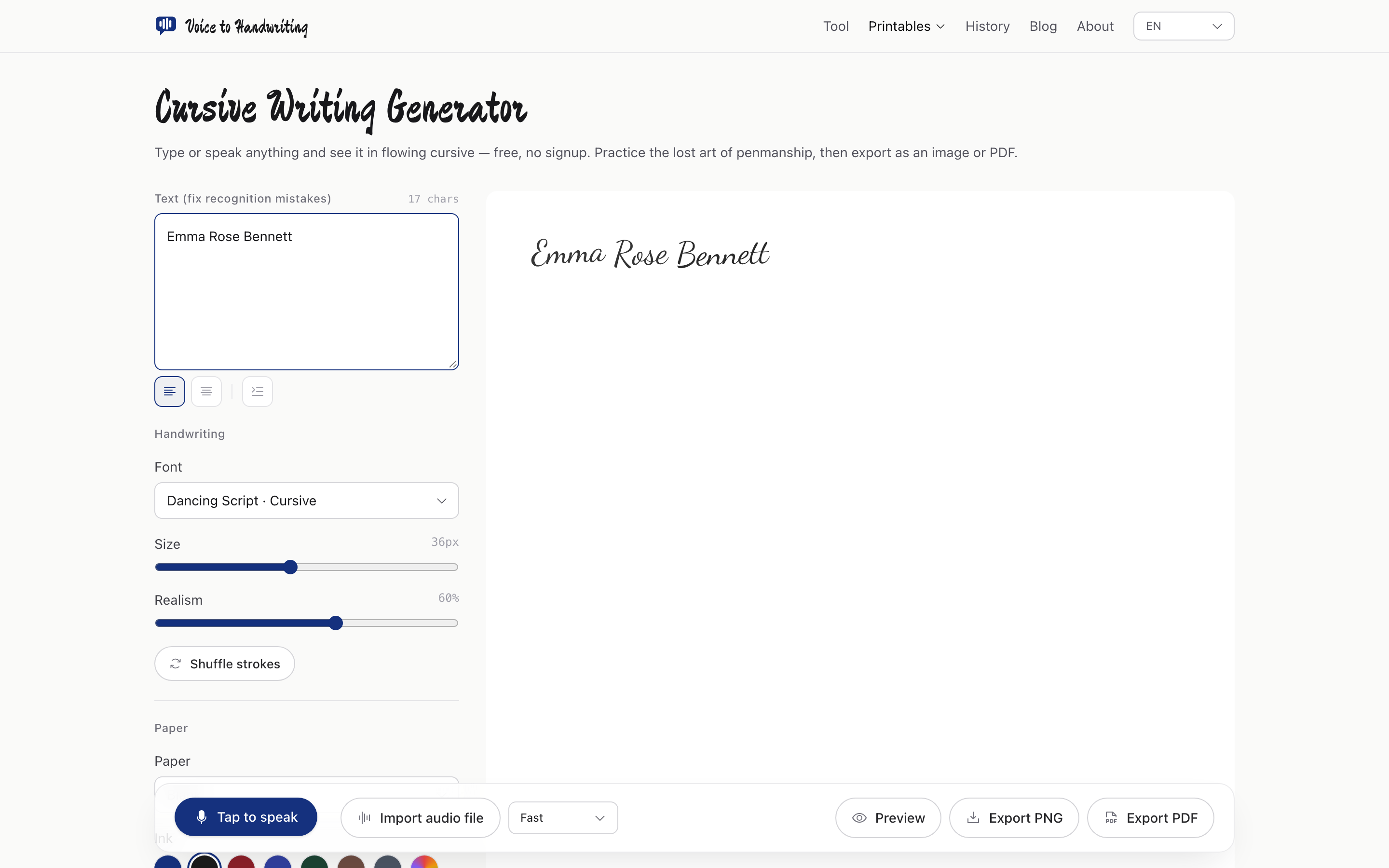
- Set your model. Type your name into the cursive writing generator, pick a font, and print it large. Try both styles: Cedarville Cursive for everyday penmanship, Dancing Script for something more formal;
- Trace it, five to ten times, on the printed page. Don't analyze — let your hand learn the route;
- Copy it freehand on the line below, eyes on the model. Compare after each attempt: which letter drifts? (It's almost always r, s, or a b/o/v/w connection — see the cursive alphabet guide);
- Lock the size. Your name should sit inside the same band height every time. The name tracing generator prints your name on three-line guides at whatever size you set — start big, shrink weekly.
Five minutes a day for a week puts most people at "reads clearly and looks the same every time." That's the foundation — signatures are style added on top of a name you can already write.
Stage 2: design a signature (the adult upgrade)
A signature isn't beautiful handwriting — it's a fast, consistent, hard-to-copy gesture. Design it in this order:
| Lever | Options | Rule of thumb |
|---|---|---|
| First initial | Keep full name, or initial + last name | Shorter = faster = more consistent |
| Capitals | Exaggerate size, add a loop or flourish | One flourish, not five |
| Connections | Break the name into 1–2 chunks | Full-name connections look great but fall apart at speed |
| The tail | Underline sweep, final-letter stroke, dot | The tail is your "brand" — make it deliberate |
The classic formula adults land on: big first capital, simplified middle (some letters reduced to bumps), decisive tail. Think of how doctors sign — illegible middle, unmistakable skeleton.
Test your signature before you commit
The three-pass test, done three days in a row:
- Speed: can you sign it full-speed, like you're at a card terminal?
- Consistency: lay three signatures side by side — same skeleton, same slant, same tail?
- Recovery: sign it after writing two paragraphs (hand fatigue test)?
If it passes, sign everything — birthday cards, coffee-shop receipts, that "sign here" tablet — for a month. Muscle memory is built by volume, not by rehearsal.
Practice shortcuts that actually work
- The tracing ladder: print the same name at 3 sizes (big → medium → your natural size) and trace down the ladder. Big movements build the shape; small ones build speed;
- First-name sprint: practice your first name 20 times, last name once — it's the first name that needs the volume;
- Try sibling styles: write your name in both generator fonts and steal one feature from each (the Dancing Script capital, the Cedarville lowercase rhythm).
Tested, with honest limitations
- Printing from the generator gives you a model to trace and copy — it won't make your hand write cursive for you, and there are no stroke-direction arrows; pair it with the step method above;
- PDFs are free, no watermark, and rendered in your browser — your name never leaves your device;
- Legibility matters where it matters: signatures on legal documents need consistency more than beauty. Illegible-but-consistent beats beautiful-but-different-every-time.
People also ask
- How do I write my name in cursive if I've never learned cursive? Start with your name's letters only — find them in the cursive alphabet guide, trace a printed model, then copy freehand. Most people reach legible in a week of short sessions.
- Does your signature have to be your name? Legally it generally needs to be a consistent mark you intend as your signature — most people keep a recognizable version of their name for important documents.
- What makes a signature look good? Consistency, one deliberate flourish, and confident speed — not completeness. A simplified, repeatable skeleton beats a fully-written name that wobbles.
- Can I practice my signature on a tracing sheet? Yes. The signature practice sheet prints one form: a solid line, a dotted line, then blank lines, in four signature scripts. Use name tracing when the letters still need to be large on three-line paper.