How to teach cursive writing to kids at home (10-minute lessons)
Tomorrow morning at the kitchen table, the lesson is one letter family and ten minutes. Then you stop. 10 focused minutes, three times a week, beats any workbook marathon.
Adults learning cursive for themselves should use how to write in cursive. Parents checking whether school still has to teach it should read is cursive still taught. This page is the at-home lesson, usually for a child of 7 or 8.
Tomorrow's 10 minutes (three times a week)
- Warm-up (2 min): one line of the week's family stroke — ramps, bumps, or waves;
- Trace (3 min): type the day's letters or words into the cursive writing generator, print, and have your child trace the model — pencil on the printed letters, saying each letter's name out loud;
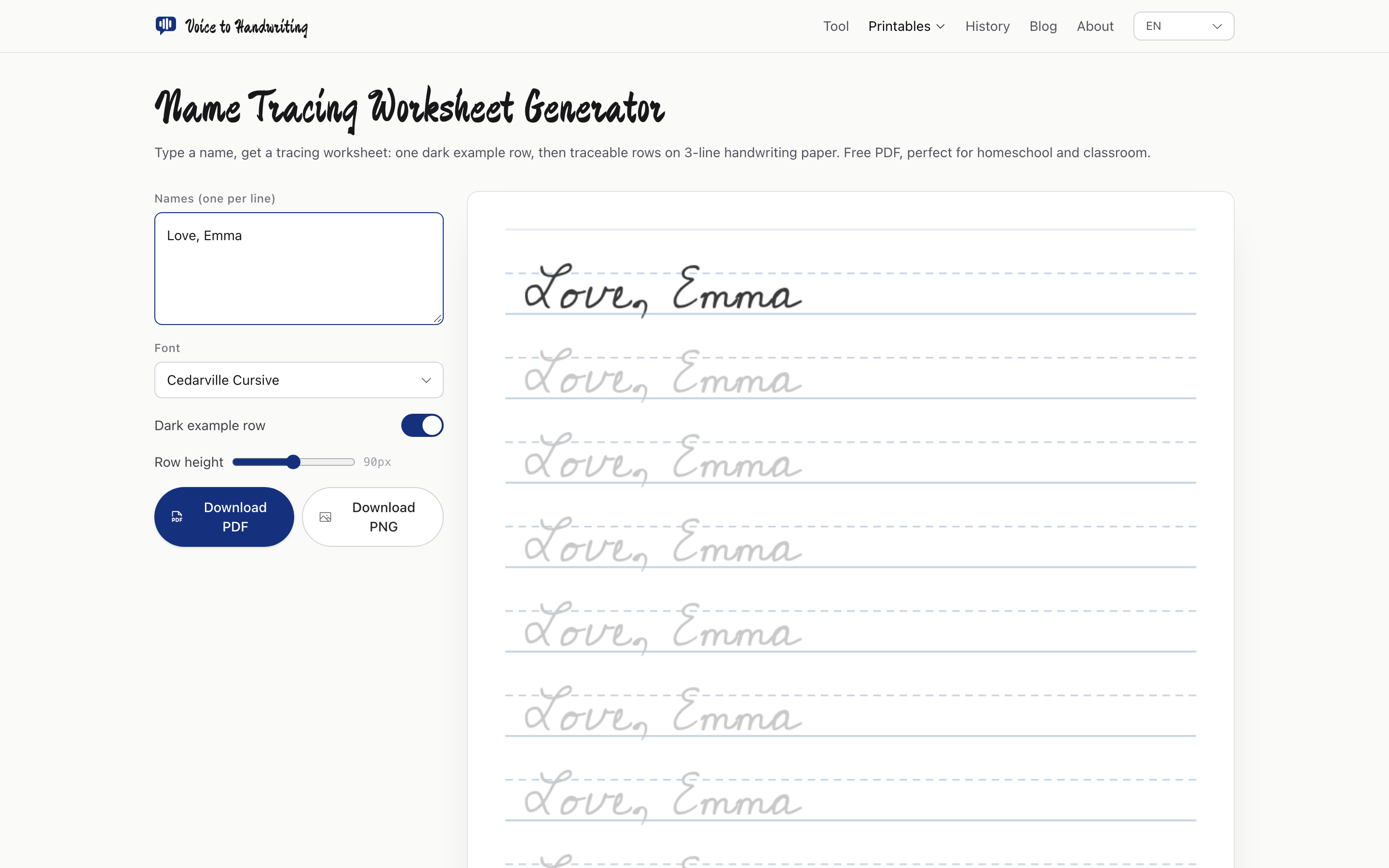
- Copy (3 min): same words freehand on the next line of three-line printable paper, eyes on the model. For names, the name tracing generator makes a sheet with the example row printed dark and tracing rows in light gray;
- One win (2 min): your child circles their best letter. End there — never on a correction.
Keep a dated sample once a week. Six weeks later, put the first and last side by side; the visible progress is what makes the kid ask to keep going. For the tracing step, the cursive worksheets generator turns any word list — this week's letter family, a name, a spelling word — into a ready-to-trace sheet.
Teach letters in this order (not alphabet order)
Cursive letters share strokes, so teach by family — each new letter is a small twist on yesterday's letter:
- Week 1–2 — Ovals: c → a → d → g → o → q. One circle, six exits. Kids get the "aha" here: a is just c closed up;
- Week 3 — Waves: i → t → u → w → e, then tiny real words: it, at, wet, tie. First connections happen this week — make it a ceremony;
- Week 4 — Bumps: n → m → h → b → r → p, and the words him, ham, man, run;
- Week 5 — Loops + the rest: l, f, k, j, s, v, x, y, z;
- Week 6+ — Their name and capitals: the payoff week. Start with the 8 workhorse capitals (C, L, M, N, S, T, J, R), then their own name.
Teach the connection rules early and plainly: lowercase letters shake hands at the baseline, but o, b, v, w end high and usually don't shake hands with the next letter. Kids who learn this skip the single biggest frustration of self-taught cursive.
Is your child ready? (usually ages 7–8)
Wait for these three, in rough order of importance:
- Print handwriting is mostly automatic — they can write letters without drawing them. Cursive on top of unfinished print creates one muddy style;
- Fine motor stamina — they can write a full line without the grip going white-knuckle (the pencil test: a relaxed grip you could slide a finger under);
- They want the "grown-up writing" — cursive lands best sold as a secret code or a superpower, not as remediation.
Starting at 7 with enthusiasm beats starting at 6 under protest. Cursive isn't urgent; it's a two-month project in a childhood that's years long.
Mistakes that kill home cursive (from teachers who've seen it)
- Starting with capitals — they're the least standardized, most ornamental letters and the fastest route to "I can't do this";
- Practicing for 30 minutes once a week — motor memory consolidates with short, frequent sessions; long sessions mostly rehearse fatigue;
- Correcting during the lesson — save feedback for the "circle your best letter" moment and next lesson's target;
- Mixing the message — if school says D'Nealian-style and home models a different style, pick one at home and stay consistent. (Our generator's fonts are everyday handwriting styles, not curriculum-licensed fonts — close enough for fluency practice, and we say so up front.)
People also ask
- What grade do kids learn cursive? Traditionally 2nd–3rd grade; in the 20+ states that restored cursive requirements, it's spread across grades 1–6, often with light touch.
- Should my child learn print and cursive at the same time? No — print first, until it's automatic (usually age 7+), then layer cursive on top.
- How long does it take a child to learn cursive? With 10-minute sessions three times a week, most kids write all lowercase letters plus their name within 6–8 weeks.
- What if my child refuses to practice? Shrink it — two traced words, then done — and let them pick the practice words (their name, their pet, a joke). Refusal usually means the session got too long or too corrective.