Pen pal letters for kids: the friendly letter format + printables
Pen pals are quietly having a comeback — classrooms pair up across states, grandparents sign up as "class grandfriends," and scout troops trade letters with troops abroad. For kids, it's the rare writing task with a real audience and a real mailbox payoff.
Here's the friendly letter format US schools teach, prompt ideas that unstick writer's block, and the printable paper that keeps 2nd-grade handwriting inside the lines.
The five parts of a friendly letter
This is the structure teachers grade against (a classroom staple around 1st–3rd grade):
| Part | What it is | Example |
|---|---|---|
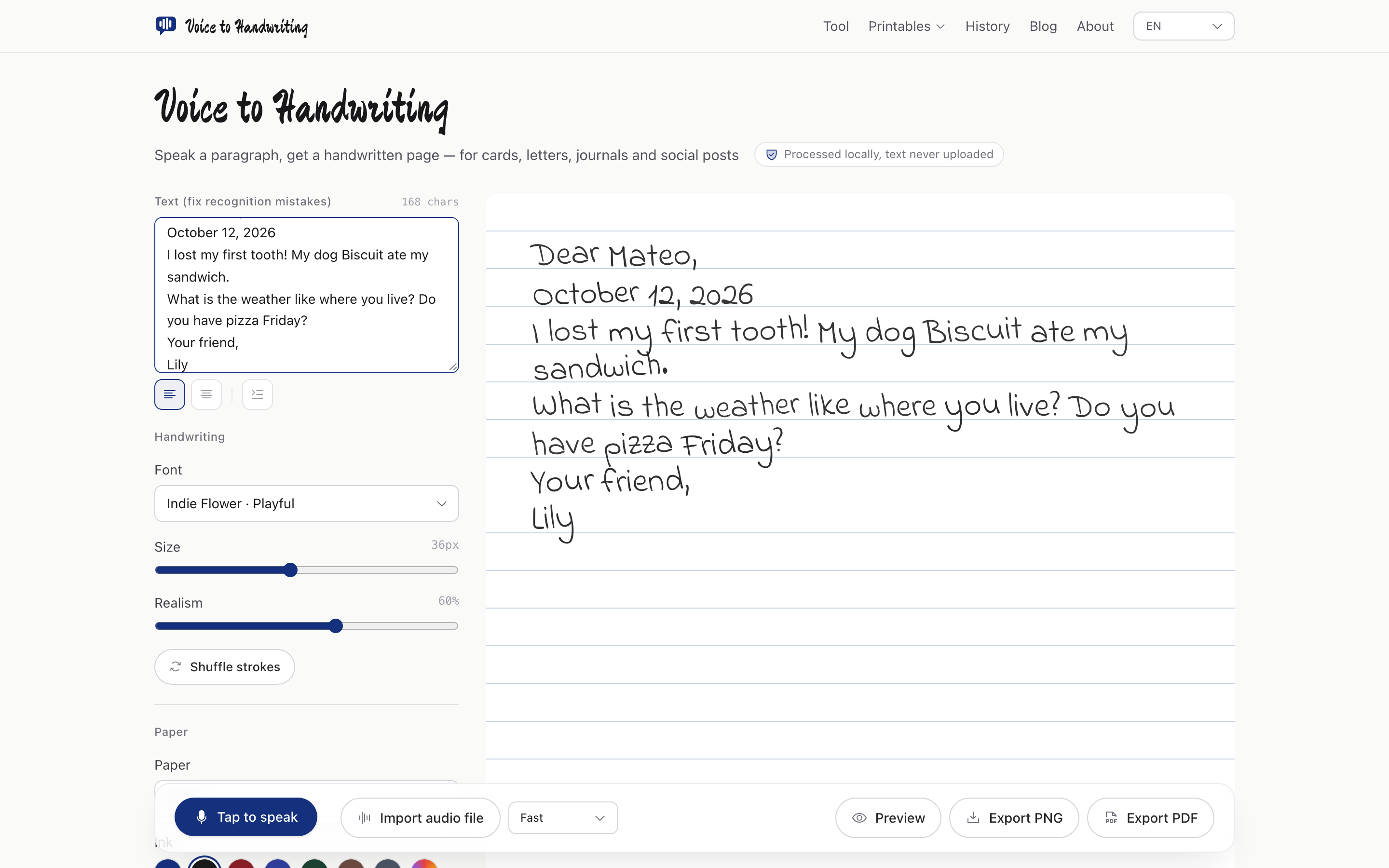
| Heading | Date (and sometimes address), top right | October 12, 2026 |
| Greeting | Salutation, followed by a comma | Dear Mateo, |
| Body | The news, 1–3 short paragraphs | I lost my first tooth! … |
| Closing | Sign-off, lined up with the heading | Your friend, |
| Signature | First name only for kids | Lily |
The two kids always forget: the date and the comma after the greeting. Make a game of spotting them in each other's letters.
Prompt bank: questions that get answers
The trick to a letter that gets a reply is ending with questions the other person wants to answer:
- "What's the weather like where you are? It snowed here — in October!"
- "What's your school lunch like? Ours has pizza Friday."
- "What's something weird that happened to you this week?"
- "If you could have any pet, real or imaginary, what would it be?"
- "What's the best book your teacher has read to you?"
One piece of news + two questions = a letter that writes itself in ten minutes.
Printables that keep letters on the rails
- Ruled paper with a wider spacing — early elementary writers need wide-ruled or larger; the printable paper generator lets you slide the line spacing to match your kid, pick a fun line color, and print Letter-size sheets free;
- Handwriting paper with the dashed middle line — for 1st–2nd graders whose letters still wander;
- Name practice sheets — the name tracing generator makes a sheet with "Your friend, Lily" or the pen pal's name to trace, which doubles as signature practice for kids still learning to write theirs;
- A model letter in a friendly font — type a sample letter, print it, and let your child use it as their format reference for the first month.
Classroom version: the whole class, one afternoon
Teachers running a pen pal program: paste your class roster into the tracing generator (one name per line) for signature practice sheets, print a stack of custom-spaced paper, and project one model letter. Total prep time is about 15 minutes — the letters' first draft can happen the same day, before enthusiasm fades.
Tested, with honest limitations
- Everything here is free and browser-based — the generators run locally, and no names or text are uploaded to a server;
- Fonts are open-source handwriting styles; the model letters won't match a specific handwriting curriculum;
- For pen pal matching itself, use school-organized programs, family connections, or established services that screen participants — kids' last names and home addresses stay off the letters.
People also ask
- What are the five parts of a friendly letter? Heading, greeting, body, closing, and signature — with a comma after the greeting and the closing lined up with the date.
- What is a good first letter to a pen pal? Introduce yourself with three facts (name, age, something you love), describe one day-in-the-life detail, and end with two questions.
- How often should pen pals write? Once a month is sustainable for classrooms; fortnightly works for enthusiastic pairs. Faster than that, replies become homework.
- Where can kids find safe pen pals? Through school or troop programs, relatives, and vetted services — and keep personal details like addresses out of the letters themselves.