Kindergarten handwriting paper: what the three lines teach
You've seen it on every kindergarten desk: paper with a solid top line, a dashed line down the middle, and a solid bottom line. It looks like decoration. It isn't — those three lines are a coordinate system for every letter your child will write this year.
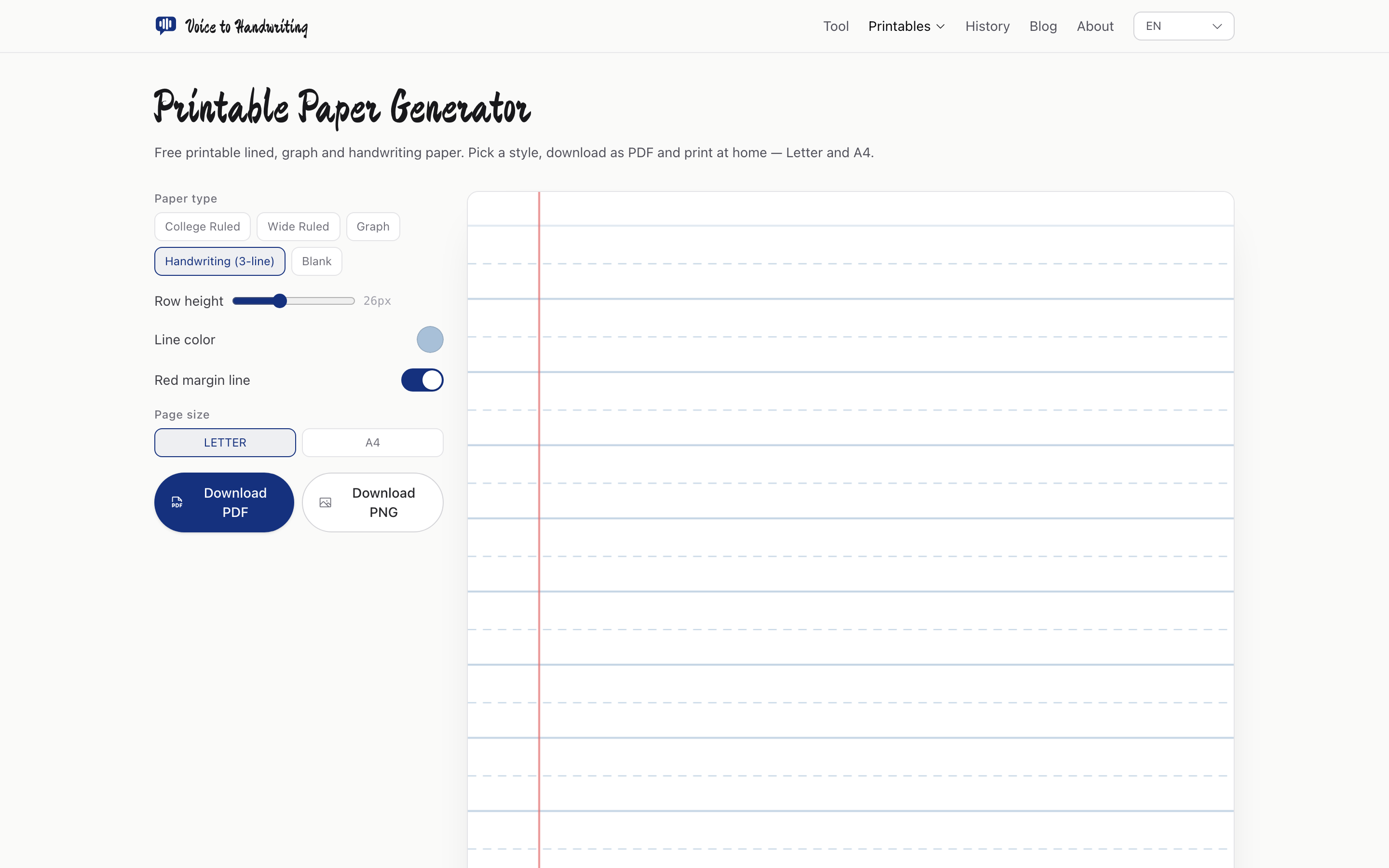
Here's what each line does, how teachers describe it, and how to print free three-line handwriting paper for kindergarten at home. US Letter holds 12 of these lines, with a red margin line on the left. Print at actual size. Fit-to-page moves the dashed line.
The anatomy of three-line paper
| Line | Name teachers use | What it does |
|---|---|---|
| Top (solid) | "Sky line" / ceiling | Tall letters (b, d, f, h, k, l, t) touch it |
| Middle (dashed) | "Fence" / waist | Where most lowercase bodies stop — the single most important line |
| Bottom (solid) | "Ground" / baseline | Every letter stands on it; "tail" letters (g, j, p, q, y) dive below |
The dashed middle line is the whole trick. Without it, a lowercase a and a capital A are just "big and bigger." With it, letters sort into three easy families:
- Tall letters — touch the sky line: b, d, f, h, k, l, t (and capitals);
- Small letters — start below the fence, sit on the ground: a, c, e, m, n, o…;
- Descending letters — dive under the ground: g, j, p, q, y.
That's the language to use at home. "That's a tall letter — does it touch the sky?" lands better than "watch your ascenders."
Pick the right band size for the age
Bigger hands need bigger bands. On the printable paper generator, the handwriting type has a band height slider:
- Preschool (3–4 yrs): tallest bands — whole-hand grip, huge letters;
- Kindergarten (5–6): large bands, usually starting midway through the year;
- 1st–2nd grade: shrink toward half the height as letters get consistent.
The rule of thumb: if your child's letters don't fit inside one band or spill across two, the band is too small — not the child's fault.
A 10-minute practice loop that works at home
- Model it (2 min): write one letter yourself, saying the strokes aloud — "down, up, over" for lowercase a;
- They trace (3 min): 5–6 letters, your hand over theirs if needed, then fade away;
- They copy (3 min): same letter freehand next to yours, eyes on the model;
- Hunt (2 min): find one great letter and circle it — end on success, not correction.
For the first word worth practicing — their name — skip blank paper entirely and use the name tracing generator: same three-line bands with their name pre-printed dark, then in light gray to trace.
Tested, with honest limitations
- The generator draws top line, dashed midline, and baseline with an adjustable red margin toggle — gray lines are also one click away if the standard blue is too busy for your child;
- PDFs are US Letter size by default (A4 available);
- No letter-by-letter stroke arrows or numbered prompts — that guided-letter level is where commercial workbooks still earn their price. For most practice, the three lines plus a modeled example are enough.
People also ask
- What is the paper with a dotted middle line called? Usually "three-line handwriting paper" or "primary writing paper"; teachers also say "fence paper" or "sky-ground paper."
- Should kindergarteners use three lines or two? Three lines with the dashed middle first — the midline is what teaches letter proportions. Two-line paper comes later, around 1st–2nd grade.
- What size lines for kindergarten? Start with the tallest bands (about an inch) and shrink as control improves — the slider goes down to smaller bands for first graders.
- Can I put my child's name on this paper? Yes — the name tracing generator uses the same three-line system with the name filled in.