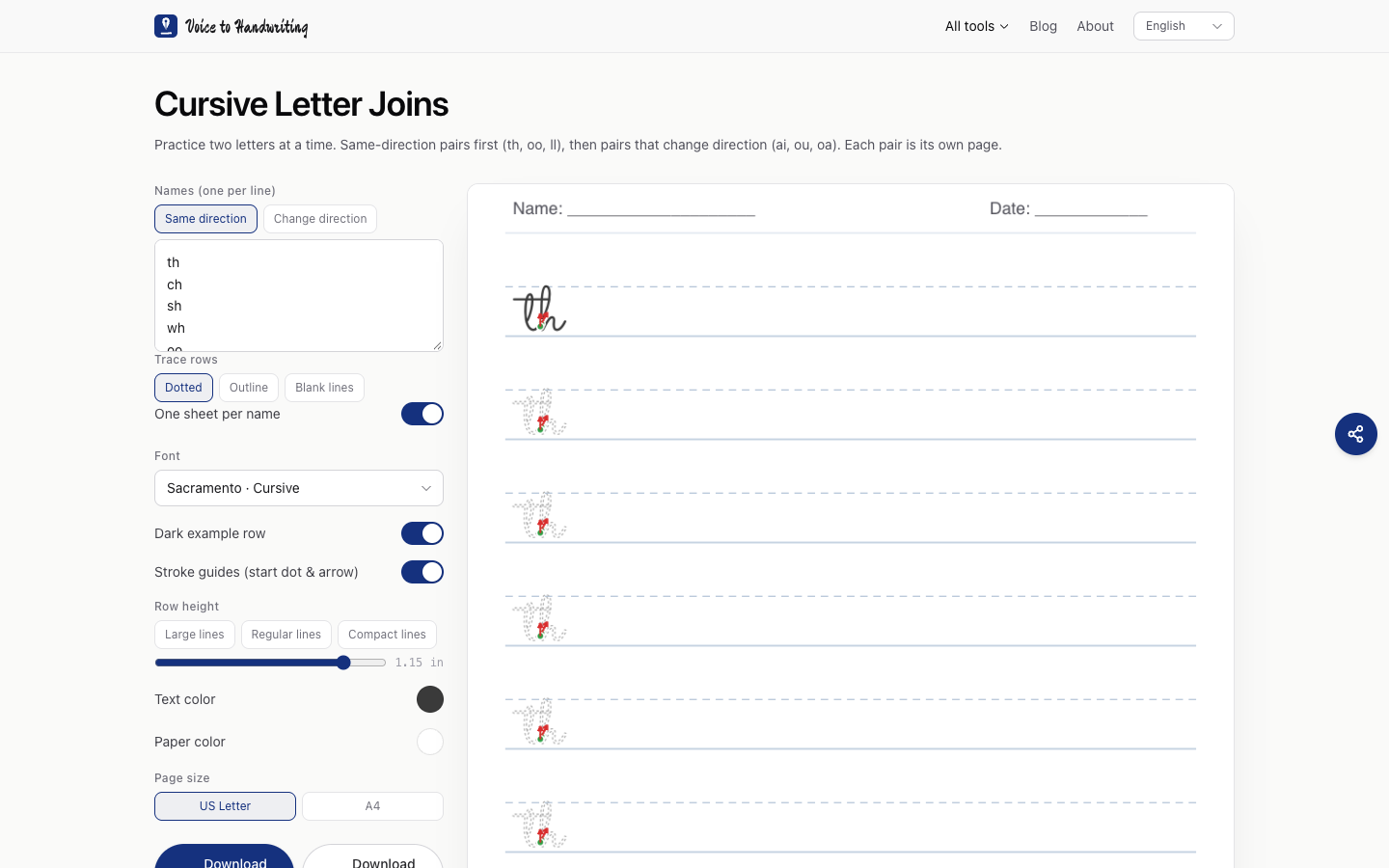
How two cursive letters connect, same way or a turn
A child who can write a cursive t and a cursive h still stops between them. The join is that middle stroke. I print cursive letter joins one pair at a time, in Sacramento, so the first row is the model and the rows under it are dotted.
Which pair, by age
| Age | Pairs | Why these |
|---|---|---|
| 6, once cursive has started | th, ll, ee | The hand keeps going the same direction. |
| 7–8 | oo, ss, ch, sh, wh, then ai, ou, oa | Same-direction pairs first. Turning pairs change direction in the middle. |
| 9+ | A word they already use, on cursive worksheets | The pair pages are the warm-up. The word is the test. |
Same direction on the sheet: th, ch, sh, wh, oo, ee, ll, ss. Change direction: ai, ay, ou, ow, oa, ea, ir, er.
Single letters stay on the cursive alphabet. This page is the connection.
Tomorrow morning
Leave the sheet on Same direction. Print th. Finger along the join, then pencil on the dots, one page. Watch whether the pencil lifts between the two letters. The rest of the pairs can wait.
When the join turns into a scribble
Go back to a pair they can already do, usually ll or ee. Cover the model after two clean dotted rows. A full word on day one teaches the hand to rush the join. The pages are free, with no account.
The guide for teaching cursive at home covers the weeks before these pairs. This page starts the day two letters have to touch.