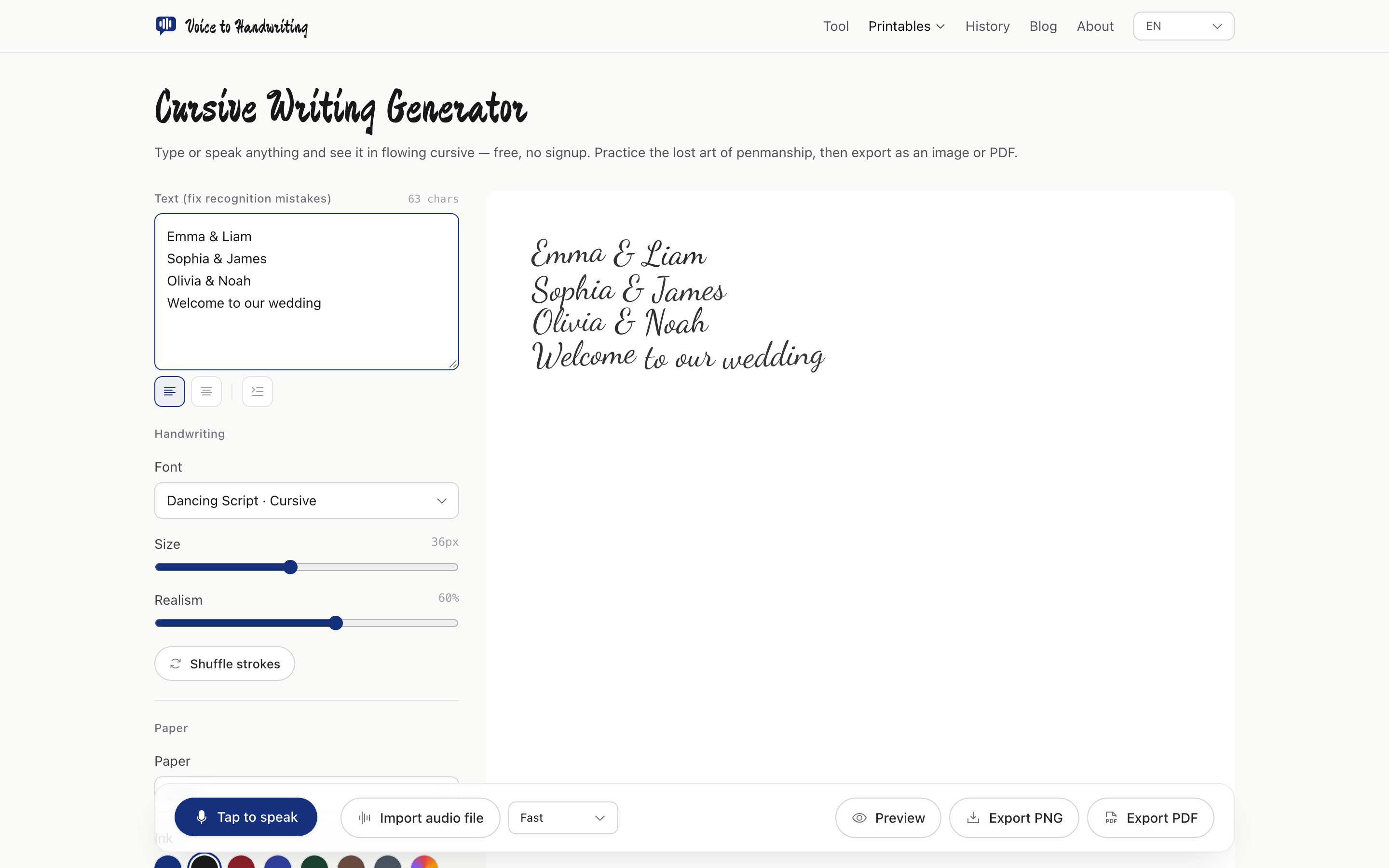
DIY wedding calligraphy: place cards & signs without hiring a calligrapher
Professional calligraphy runs $2–5 per place card — on a 120-guest wedding, that's a line item. The good news: for most paper goods, guests can't tell DIY from pro at three feet away, and the two that do reveal amateur work have workarounds.
Here's how to get calligraphy-style place cards, menus, signs and vow keepsakes from your own printer, free.
Where DIY script works — and where it doesn't
| Paper good | DIY verdict | Why |
|---|---|---|
| Welcome sign | ✅ Great | Big format forgives everything |
| Menus, bar signs, favor tags | ✅ Great | Read at a glance, printed by the dozen |
| Place cards / escort cards | ✅ Good | See the tracing trick below |
| Envelope addressing | ⚠️ Special case | Guests see the mail before the wedding; hand-address these |
| Vow / keepsake prints | ✅ Great | You frame it, so your standard is the only one |
Step 1: set your words in a script font
Open the handwriting tool and paste your guest list or text. Two fonts cover the wedding look:
- Dancing Script — looped and formal, the safe choice for headings, names, and signs;
- Cedarville Cursive — lighter, more personal, lovely for vows and quotes;
- Body details (menu items, dates) in Caveat keep things airy.
Export as PDF — it stays vector-crisp at any print size, unlike screenshots.
Step 2: print on the right paper
- Place cards: print on white or cream cardstock (65–80 lb) and trim;
- Signs: most office/print shops print PDFs on poster stock same-day for a few dollars;
- Menus: standard paper is fine — the font does the work.
One line-color tweak goes a long way: gray or navy ink reads more elegant than pure black on cream paper.
Step 3 (place cards): the window-tracing trick
The honest gap between DIY and pro is consistent slant across 100 names. Close it like calligraphers fake it:
- Print all names from the PDF as a spacing guide — same font size, one per line;
- Tape the guide sheet to a bright window (or a light box if you own one);
- Lay blank place cards over it, one by one, and trace the names with a fine-tip pen — Micron 03 or a gel pen.
Ten minutes per dozen, and every name leans the same way. Since the guide is just printed paper you already have, the only "cost" is tracing time.
The vow keepsake
Type your vows, set them in Cedarville Cursive on blank paper with generous margins, print on cardstock, and frame. Couples commonly print his-and-hers pages for a paired frame — and doing it yourself means the wording can be edited the night before the anniversary print, for free, forever.
Tested, with honest limitations
- These are real handwriting fonts, not hand-lettering art — expect a clean calligraphy style, not flourished copperplate with swashes;
- The editor renders at 2× density, so cardstock prints stay crisp; for anything larger than letter size, use the PDF at a print shop rather than scaling a PNG;
- Free, no signup, and nothing you type leaves your browser.
People also ask
- What font is closest to wedding calligraphy? Dancing Script is the closest free looped style; pair it with Cedarville Cursive for body text.
- Is it tacky to print place cards instead of hand-lettering them? No — printed calligraphy-style place cards are standard at weddings; guests notice legibility, not provenance.
- How do you fake calligraphy at home? Print the words as a guide and trace them onto the final card over a window — same slant, same spacing, hand-done ink.
- Can I address envelopes with a handwriting font? You can, but the invitation suite is where hand-addressing is most noticed — print a guide sheet and trace those, too.