Alphabet in Cursive
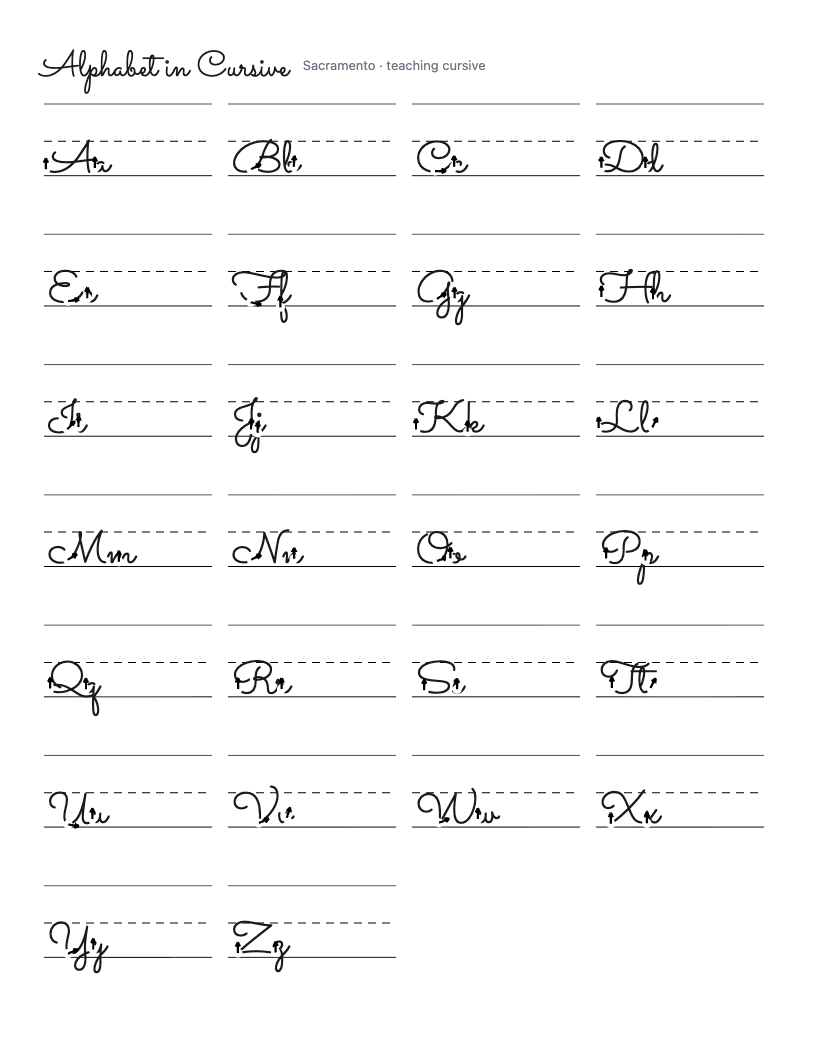
The alphabet in cursive, uppercase and lowercase. Tap any letter to see it full size on a three-line guide, with a green dot marking where the pen lands and an arrow showing the first stroke direction. Switch between a D'Nealian-style teaching cursive and everyday handwriting fonts, then download the practice sheet or the whole chart as a free printable PDF — no email wall.
More free printable cursive charts
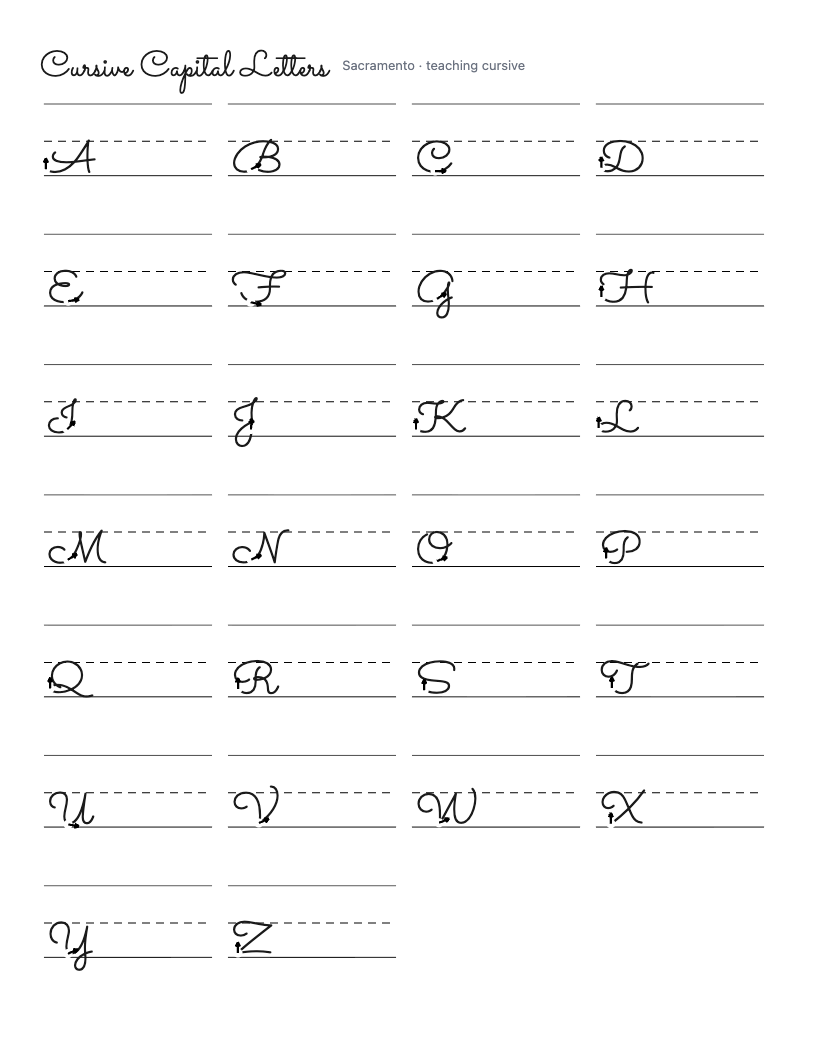
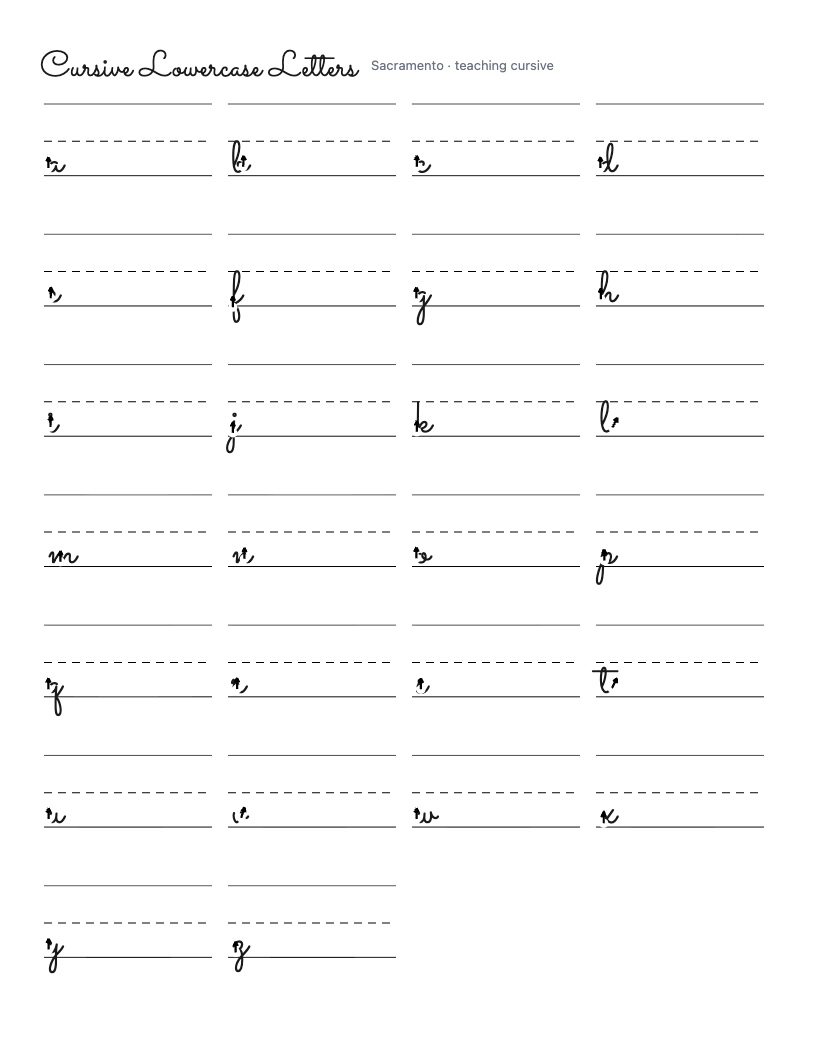
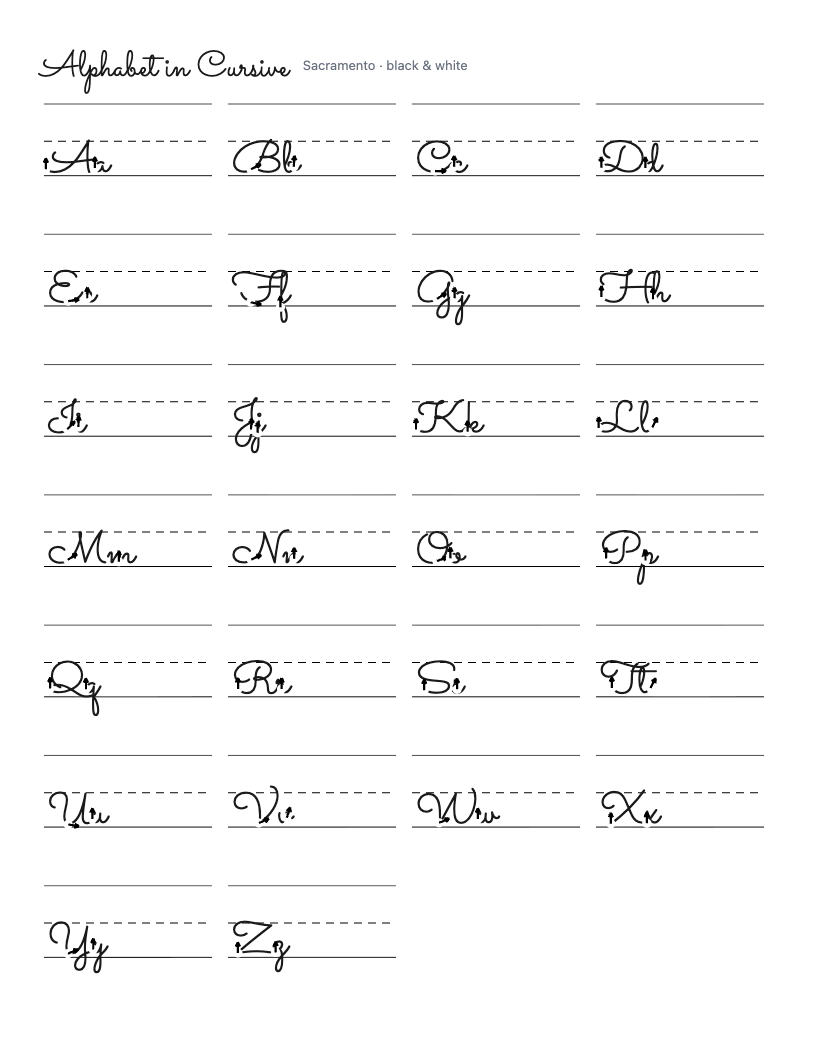
Every chart below is a ready-to-print PDF: page one is the reference chart with start dots and arrows, page two adds a dashed copy of each letter to trace.
Compare the print fonts (Kalam, Patrick Hand) with cursive to see why the connected strokes change letter shapes.
Words to practice: apple · and · cat · rain · happy
Open the step-by-step lesson → Cursive aWant custom words instead of the alphabet? The cursive worksheet generator takes any word list, and the cursive writing generator renders full sentences you can trace or export.
A free interactive cursive alphabet chart
A cursive alphabet chart shows all 26 letters in both capital and lowercase forms so you can see each shape, its starting point, and how it connects to the next letter. Most charts online are static pictures: this one is interactive, so you can pick a letter, watch where the pen lands, and compare a D'Nealian-style teaching cursive (Sacramento) with everyday handwriting fonts before you commit anything to paper. Capitals and lowercase letters follow different logic. Capitals share shapes with print writing but gain entry flourishes; lowercase letters are rebuilt around continuous strokes and exit connectors — which is why letters like b, f, g, and z trip up almost everyone. Every letter, lowercase and capital, has its own step-by-step lesson on this site, linked right from the chart. When you are ready to practice, download the free printable cursive alphabet PDF. Page one is the uppercase and lowercase chart with start dots and direction arrows. Page two puts a solid example and a dashed copy of every letter on the same line. It prints on US Letter paper and pairs with the site's cursive worksheet generator if you want custom words.
Cursive alphabet FAQ
What is the cursive alphabet?
The 26 letters of the Latin alphabet written in a connected style, where most letters end with an exit stroke that flows into the next letter. A full chart shows each letter in capital and lowercase form, ideally with the starting point and stroke direction marked — that is what the green dots and arrows on this page do.
Which cursive font matches what schools teach?
Most US classrooms use either Zaner-Bloser or D'Nealian styles. Sacramento, the default font here, is an open-source font with continuous entry and exit strokes, which makes it the closest free match to D'Nealian cursive. Cedarville Cursive is closer to natural everyday handwriting. Neither is an official school font, but both are honest practice models — your hand will develop its own version.
How do I print the cursive alphabet chart?
Use the free printable cursive alphabet PDF linked on this page. Page one is the uppercase and lowercase chart with start dots and arrows. Page two is a solid example and a dashed copy of every letter. The buttons under the letter panel rebuild that PDF in the font you picked, and the PNG is the current letter only. Files are generated in your browser — nothing is uploaded, and there is no signup or email wall.
What order should I learn the cursive alphabet in?
By stroke family rather than A to Z: start with letters built from simple up-and-over strokes (i, t, u, w), then cursive climbs like e and l, then bumps (n, m, h), then the harder loops and descenders (b, f, g, j, q, z). The chart lists lessons from a to z so you can find a letter; the order you practice them can still follow the stroke families.
Why do these letters look different from my old school chart?
Every cursive tradition — Zaner-Bloser, D'Nealian, Palmer, italic — draws the same 26 letters with slightly different flourishes, and this site uses open-source fonts rather than a licensed school script. The stroke logic and starting points transfer between them; treat the differences as dialects, not mistakes.
Voice to Handwriting · voicetohandwriting.online